

We currently have 17 in stock.
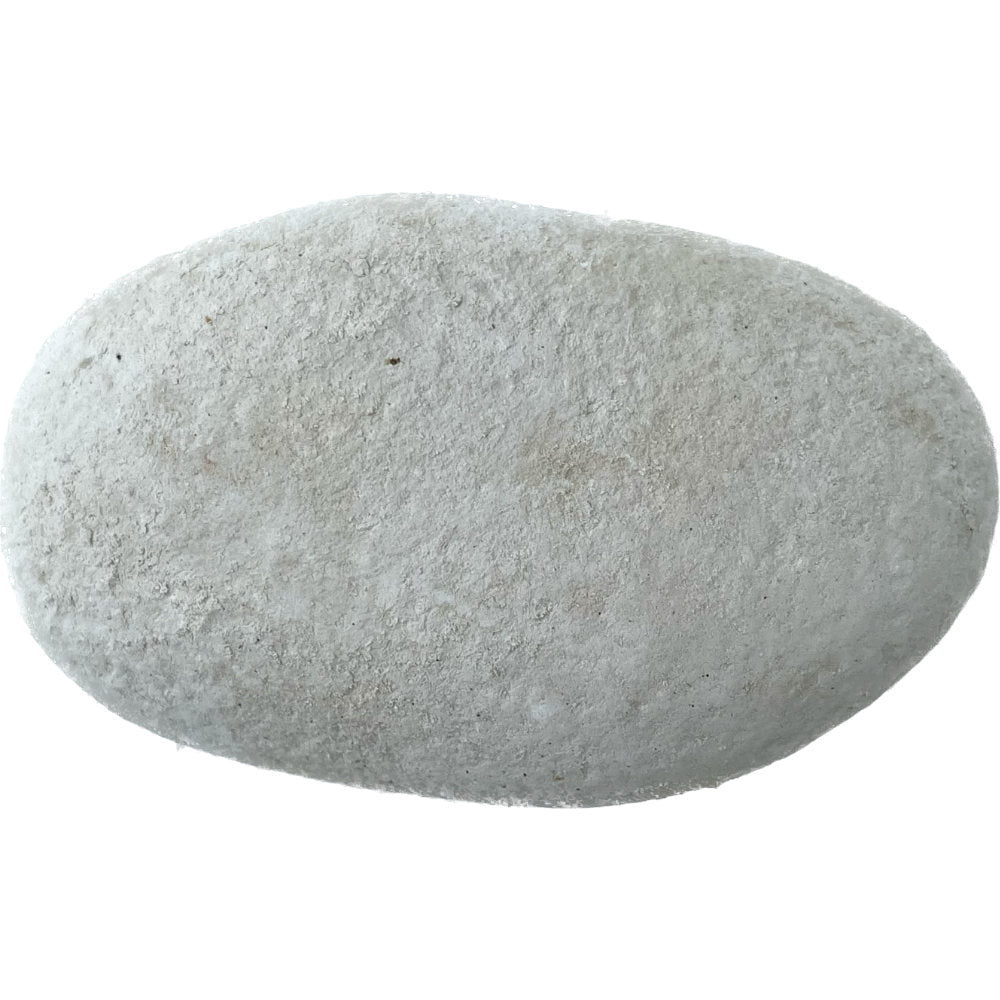
This 'chalk' is a soft and very white type of limestone rock, being composed mainly of calcium carbonate minerals. It often features finely grained, microscopic shells. These samples are rounded by physical abrasion during river and/or wave transport.
The smooth surfaces make rounded rocks especially suitable for scratch tests to determine hardness.
Sedimentary: Technically an 'organic sedimentary' rock.
Source location: Marlborough.
Sizes: Choose from dropdown menu either Shelf specimen (300–800g), or Hand specimen (150-300g), or Small specimen (less than 150g).
Note: Images are examples of specimens only. Sizes and shapes will vary.
More detail
Structure
A soft sedimentary rock that is formed from the accumulation of microscopic marine fossils such as foraminifera and coccoliths, and is therefore composed mainly of calcium carbonate minerals.
Type
Organic sedimentary.
Physical Properties of chalk
- Colour: Typically very white.
- Lustre: Dull.
- Texture: A fine-grained texture and is soft to the touch.
- Hardness: 1 to 2 on the Mohs scale, making it very soft.
- Density: Ranges from 1.5 to 2.7 grams per cubic centimetre.
- Porosity: Porous, with a porosity ranging from 30% to 60%.
General Properties of chalk
- Solubility: Chalk is soluble in acidic water, which can result in the formation of karst landscapes such as caves and sinkholes.
- Chemical Reactivity: Chalk is reactive with acids e.g. white vinegar, and can be used as a source of carbon dioxide gas.
- Carbonate Buffering: Chalk has the ability to neutralise acid, which makes it useful in environmental applications such as water treatment and soil stabilisation.
Uses of chalk in New Zealand and worldwide
- Education and art: Historically In its soft form, chalk was used as a writing and drawing tool on blackboards, and slate boards. (Today's blackboard chalk is a gypsum-based product.)
- Construction: In harder forms, used as an aesthetic element in landscaping, e.g. chip for paths.
- Agriculture: Used in agricultural applications to neutralise acidic soils and provide essential nutrients such as calcium and magnesium.
- Chemical Production: Used in the production of chemicals such as calcium oxide, calcium hydroxide, and sodium carbonate.
- Water Treatment: Used in water treatment to neutralise acidic water and remove impurities such as heavy metals.
- Personal Care: Used in personal care products such as toothpaste and cosmetics.
- Geological Studies: Studied by geologists to understand the processes of sedimentation and the history of the earth's crust.